RFID Card Price in Bangladesh ranges from affordable to premium depending on chip type and quality, offering secure contactless access for offices, attendance systems, and smart ID solutions.
There’s a small plastic card sitting in almost every office drawer, factory locker, and campus wallet in Bangladesh right now — and most people have no idea how much technology is packed inside it. No battery. No visible wiring. No screen. Just a card that gets tapped near a reader, and a door clicks open, or a name logs itself onto an attendance sheet. That’s an RFID card, and understanding the real RFID Card Price in Bangladesh starts with understanding what you’re actually paying for: a tiny radio antenna doing the work that used to require a metal key, a logbook, and a security guard checking faces one by one.
This guide breaks down how RFID cards work, what drives their price, and how to pick the right one — written for the office manager, school administrator, or factory owner who just wants a straight answer, not a technical manual.
Picture the old way of getting into a locked office: a metal key, a lock, physical contact, and a locksmith on speed dial the day someone loses it. RFID flipped that entirely. Inside every RFID card is a hair-thin copper coil wound dozens of times around the card’s edge, connected to a microchip the size of a grain of rice. Neither piece has its own power source — the card is, in a sense, asleep until it’s woken up.
The moment you hold the card near a reader, the reader’s own electromagnetic field acts like a wireless battery charger, waking the chip just long enough for it to whisper its unique ID number back through the same field. The whole exchange happens in a fraction of a second, faster than you can finish the word “tap.” That’s the entire secret behind why doors open, attendance logs itself, and turnstiles spin — no swipe, no insert, no contact.
A decade ago, most Bangladeshi offices and schools relied on swipe cards, paper attendance registers, or a guard physically checking ID cards at the gate. That approach had obvious cracks: swipe cards wore out from friction, paper registers could be faked or lost, and manual checks slowed everyone down during rush hour at the gate.
RFID solved these problems almost by accident. Because there’s no physical contact, there’s nothing to wear out — a well-made RFID card can survive years of daily taps without degrading. Because the chip can carry an encrypted, unique identifier, duplicating one is far harder than photocopying a paper badge or cloning a magnetic stripe. And because reading happens in an instant, RFID quietly solved the “300 students at one gate at 8am” problem that used to create long queues at school entrances every single morning.
Here’s something most buyers don’t realize until they’ve already ordered the wrong card: RFID isn’t one single technology. It’s a family of frequencies, and a card built for one frequency simply won’t be heard by a reader built for another — like trying to tune into a radio station that isn’t broadcasting.
Low Frequency (125 kHz) is the older, simpler dialect — commonly used in basic door access systems across Bangladesh. It’s affordable and reliable for straightforward entry control.
High Frequency (13.56 MHz), which includes the well-known Mifare standard, is the more sophisticated dialect. It supports encrypted data exchange, meaning the card and reader can verify each other cryptographically before granting access — a meaningful upgrade for banks, data centers, or any building where security really matters.
Before ordering a single card, it’s worth confirming which dialect your access control system already speaks. Our Access Control & Time Attendance solutions are set up to help you match the right frequency to the right reader from day one.
Unlike a printer or a camera, an RFID card’s price tag isn’t really about visible features — it’s about what’s invisible inside it: chip quality, frequency, encryption strength, and how much data the chip can store.
| RFID Card Type | Approximate Price (BDT per card) |
|---|---|
| Standard RFID Access Card | 14.00৳ |
| Premium RFID Card | 23.00৳ |
| Mifare Smart Card | Varies by chip type and encryption |
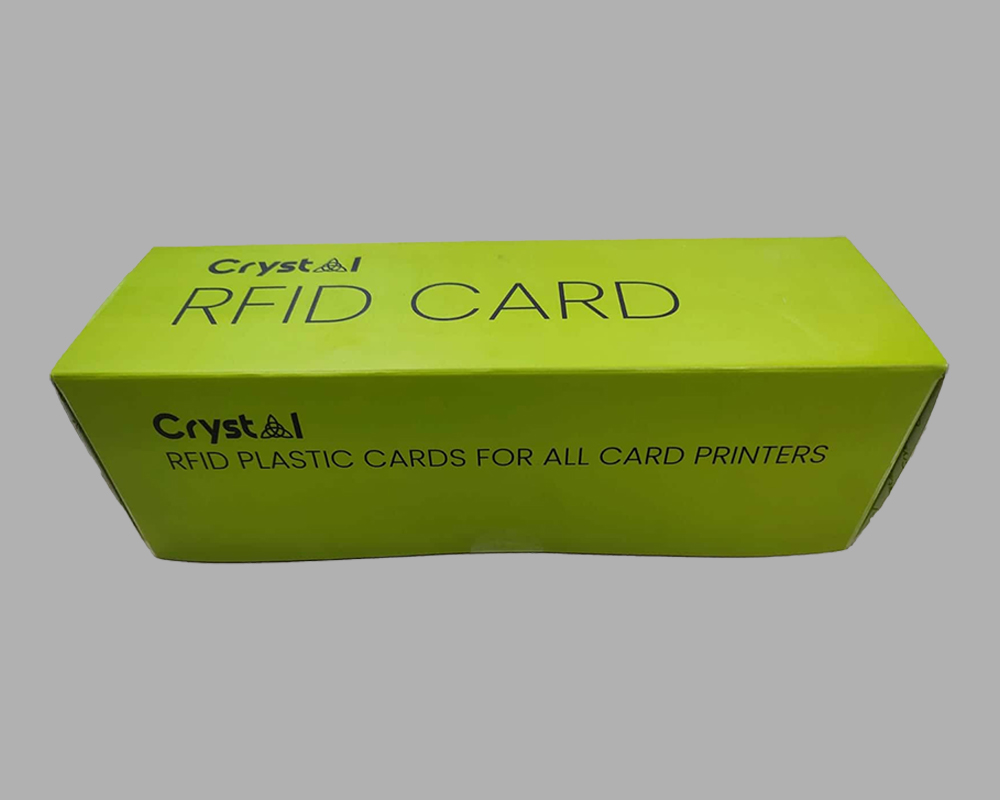
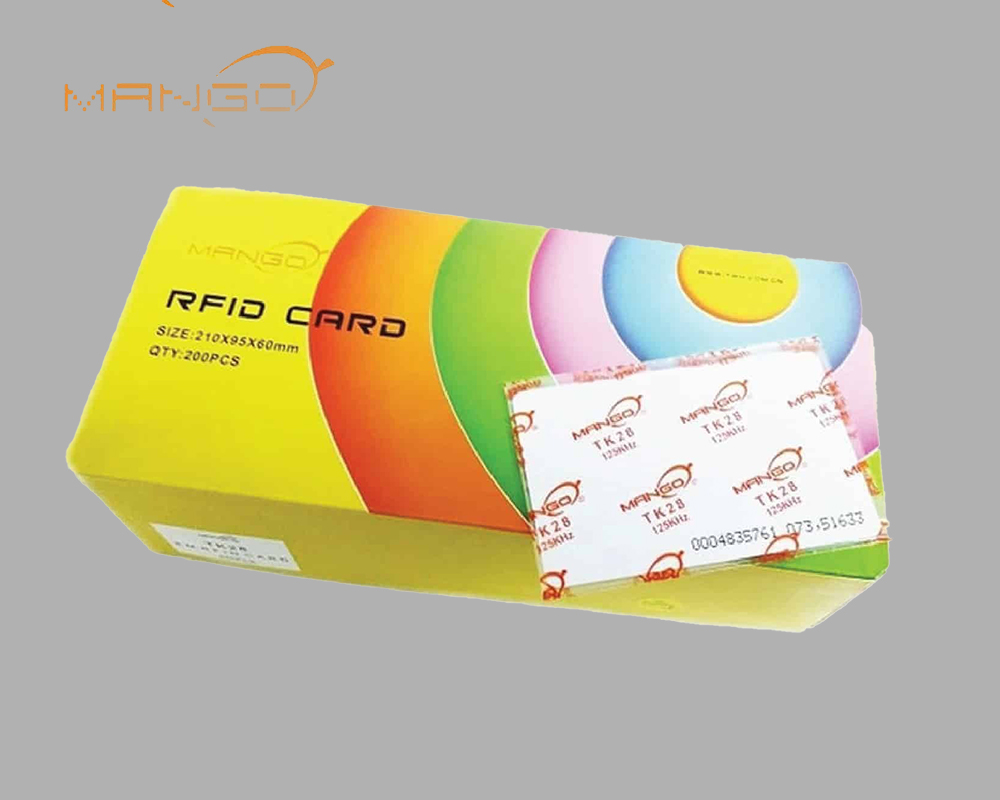
The Crystal RFID Regular Card, priced around 14৳ per piece, is the workhorse option — reliable for straightforward door access and daily attendance logging without any bells and whistles. Step up to the Mango RFID Card at roughly 23৳ per piece, and you’re paying for a stronger chip suited to organizations that want a bit more headroom for future security upgrades.
Like most imported electronics components, these prices shift with currency movement and global chip supply, so treat the numbers above as a starting reference rather than gospel — the live pricing on our RFID Card page will always reflect the current market.
If two RFID cards look identical from the outside but carry very different price tags, here’s what’s usually hiding underneath the plastic:
The single biggest mistake organizations make isn’t overpaying for RFID cards — it’s buying the wrong ones entirely and discovering the mismatch only after installation.
Before ordering, ask three questions. First: what frequency does your existing or planned reader actually speak — LF, HF, or Mifare? Buying beautiful cards that your reader can’t hear is money spent on plastic paperweights. Second: does this card need a face on it too? If your RFID card doubles as a visual ID badge with a photo and name, confirm it’s compatible with dye-sublimation printing before bulk-ordering — not every RFID card takes ink the same way a plain PVC Card does. Third: how much security does this door actually need? A staff kitchen doesn’t need the same encryption as a server room, and paying premium Mifare pricing for every single card in a large rollout can be an unnecessary expense when a mix of standard and premium cards would do the job better.
Walk through almost any modern office building, university, or factory floor in Bangladesh today and RFID is working in the background more often than people realize:
For organizations building a complete security layer, pairing RFID cards with Access Control Accessories and CCTV creates a system where the card, the door, and the camera all work together rather than as separate, disconnected tools.
Think of a plain PVC ID card as a business card that only a human can read, and an RFID card as that same business card that a machine can also understand. If your only need is visual identification — a face, a name, a logo people glance at — a standard PVC Card does the job at a lower price. But the moment that card needs to unlock a door, clock someone in, or talk to any kind of electronic system, the small price jump to RFID buys real functionality that a printed card simply cannot deliver, no matter how good it looks.
RFID cards are far tougher than swipe cards, but the antenna coil running around the card’s edge isn’t invincible. A few habits go a long way: avoid folding or bending cards sharply, since that’s the most common way to snap the internal coil; keep cards away from strong magnets or overlapping stacks of other RFID cards, which can occasionally confuse a reader trying to isolate one signal; store spares away from direct sunlight, which can warp the plastic over time; and swap out any visibly cracked card immediately, since damage near the antenna is the number one silent cause of “why isn’t my card working anymore.”
When an organization needs RFID cards for hundreds or thousands of people at once — a new academic year, a factory-wide rollout, a corporate onboarding wave — ordering piecemeal is where costs and chaos both creep in. A single bulk production run keeps chip quality consistent across the entire batch, locks in better per-card pricing than repeated small orders, and means a lost or damaged card can be replaced from existing stock instead of triggering a fresh order and a waiting period. If your organization is planning a system-wide RFID rollout, it’s worth having that bulk conversation with your supplier well before the launch date, not the week of it.
1. What is the current RFID Card Price in Bangladesh? Standard RFID access cards typically start around 14৳ per piece, while premium or Mifare-grade smart cards run higher depending on chip type and encryption. Check our RFID Card page for live pricing.
2. Can an RFID card also show a photo and name like a normal ID card? Yes — many RFID cards are built to accept dye-sublimation printing, letting you combine a visual ID badge with working access-control functionality on the same card.
3. What actually makes a Mifare card different from a standard RFID card? Mifare cards use high-frequency, encrypted communication between card and reader, making them significantly harder to clone — a meaningful upgrade for higher-security environments like banks or server rooms.
4. If I already have an access control system, will any RFID card work with it? No. Your reader is built to “hear” a specific frequency, so the card you buy has to match that frequency exactly — it’s worth confirming before placing any order, especially for existing systems.
5. Where can I buy genuine RFID cards in Bangladesh? Universe IT And Automation Ltd supplies genuine, chip-verified RFID cards for access control and attendance systems. Browse current stock or contact us for bulk pricing on your project.
An RFID card looks like nothing more than a slim piece of plastic, but it’s quietly doing the job that used to take a locksmith, a logbook, and a guard at the gate — all through a chip too small to see and a signal too fast to notice. Understanding the real RFID Card Price in Bangladesh means understanding what that invisible chip is actually capable of, and matching it honestly to what your organization needs, rather than overpaying for security you don’t need or underpaying for security you do.
Ready to order? Browse our full RFID Card collection, or get a quote from our team today for the best bulk pricing in Bangladesh.