
In today’s digital world, technology is making our lives easier, safer, and more efficient. One of the most popular innovations is the smart home automation system. From controlling lights with your phone to managing security remotely, smart homes are becoming increasingly common in countries like Bangladesh. As internet access and modern devices become more affordable, many homeowners and businesses are adopting smart solutions for better convenience and energy savings.
What is a Smart Home Automation System?
A Smart Home Automation System is a technology setup that allows you to control and manage your home’s devices automatically or remotely using a smartphone, tablet, or computer. It connects different home appliances—such as lights, fans, air conditioners, security cameras, and door locks—through the internet.
This system is powered by the concept of the Internet of Things (IoT), where devices communicate with each other and can be controlled from anywhere.
For example, you can:
- Turn off lights without getting up
- Control AC temperature before reaching home
- Monitor your home security from anywhere
- Automate daily routines like turning on lights at sunset
In simple terms, a smart home system transforms a regular house into an intelligent, connected living space that works according to your needs and preferences.
Smart Home Automation System Explained
A Smart Home Automation System is a connected network of devices that work together to control and automate household functions like lighting, security, temperature, and appliances. These systems rely on the Internet of Things, where each device communicates through the internet and responds to user commands or pre-set conditions.
Instead of manually operating everything, automation allows your home to think and act smartly based on your habits, schedules, or real-time data.
How It Works (Step-by-Step Deep Explanation)
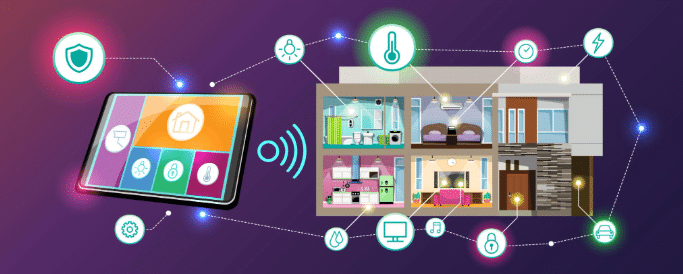
1. Input (User Command or Trigger)
Everything starts with an input. This can be:
- A manual command (via mobile app or voice assistant like Google Assistant or Amazon Alexa)
- A scheduled time (e.g., lights turn on at 6 PM)
- A sensor trigger (motion, temperature, light detection)
Example: You say, “Turn on the living room lights.”
- Communication (Internet / Wireless Protocol)
The command is sent through communication technologies like:
- Wi-Fi
- Bluetooth
- Zigbee / Z-Wave
These protocols allow devices to “talk” to each other through a central system.
- Control Hub / Controller
The system uses a central controller (hub or app) to process commands.
This can be:
- A smartphone app
- A smart hub device
- Cloud-based system
The controller decides what action should be taken.
- Action (Device Response)
Once the command is processed, the device performs the action:
- Lights turn ON/OFF
- AC adjusts temperature
- Door locks/unlocks
- Security cameras activate
All of this happens within seconds.
Basic Concept of Automation in Homes (Deep Explanation)
At its core, home automation follows a simple logic:
“IF this happens → THEN do that”
This is called conditional automation.
Example Scenarios:
- IF motion is detected → THEN turn on lights
- IF temperature rises above 30°C → THEN turn on AC
- IF it’s 10 PM → THEN lock all doors automatically
Key Elements of Home Automation
1. Sensors (Eyes & Ears of the System)
Sensors detect changes in the environment:
- Motion sensors
- Temperature sensors
- Smoke detectors
They collect real-time data.
2. Controllers (Brain of the System)
The controller (app or hub) processes data and makes decisions based on rules you set.
3. Actuators (Action Takers)
These are devices that perform actions:
- Smart bulbs
- Smart switches
- Smart locks
Why It Matters (Especially in Bangladesh 🇧🇩)
- Helps reduce electricity bills with smart energy use
- Improves security with remote monitoring
- Adds comfort and convenience in daily life
- Ideal for modern apartments, offices, and smart buildings
Simple Real-Life Example
Imagine you leave your home in Dhaka and forget to turn off the lights.
With a smart system, you can open your phone and switch them off instantly—no matter where you are.
Smart Home Automation System (Complete Understanding)
A Smart Home Automation System becomes truly powerful when all systems—lighting, security, climate, entertainment, and voice—are integrated into one intelligent ecosystem. Below is a deeper, more technical and practical explanation so you can fully understand how it works in real life.
- System Architecture (How Everything Connects)
A Smart Home Automation System is built in layers:
A. Device Layer (Hardware)
These are the physical components:
- Smart bulbs, switches, plugs
- Cameras, motion sensors, door locks
- AC controllers, thermostats
These devices collect data and perform actions.
- Communication Layer
Devices communicate using:
- Wi-Fi (most common in Bangladesh)
- Zigbee / Z-Wave (low power, stable networks)
- Bluetooth (short-range control)
This layer ensures all devices stay connected and responsive.
- Control Layer (Brain)
This is where decisions are made:
- Mobile apps
- Smart hubs
- Cloud platforms
The system processes commands using logic rules and automation.
- Application Layer (User Interface)
This is what you interact with:
- Smartphone apps
- Voice assistants like Google Assistant and Amazon Alexa
This layer gives you full control anytime, anywhere.
- Types of Automation Logic (Beyond Basic “IF–THEN”)
A Smart Home Automation System doesn’t just follow simple rules—it can use advanced logic:
A. Conditional Automation
- IF motion detected → THEN turn on light
B. Time-Based Automation
- Lights turn on at sunset
- Doors lock at 11 PM
C. Multi-Condition Automation
- IF motion detected AND it’s night → THEN turn on lights
- IF temperature > 30°C AND someone is home → THEN turn on AC
D. Scene-Based Automation
Multiple actions triggered together:
- “Good Night Mode” → Lights OFF + Doors LOCK + AC ON
E. AI-Based Automation (Advanced)
Some systems learn your behavior over time:
- Automatically adjust temperature based on your routine
- Suggest energy-saving actions
- Integration Between Systems (Real Power of Automation)
The real strength of a Smart Home Automation System is integration.
Example: Smart Living Scenario
When you arrive home:
- Door unlocks automatically
- Lights turn on
- AC starts cooling
- Your favorite music plays
All systems work together seamlessly.
- Local vs Cloud Control (Important for Bangladesh)
Local Control
- Works without internet
- Faster response
- More secure
Cloud Control
- Access from anywhere
- Requires internet connection
- Enables remote monitoring
Best setup: Hybrid system (Local + Cloud) for reliability.
- Energy Efficiency & Cost Optimization
A Smart Home Automation System is not just about comfort—it saves money.
How it reduces cost:
- Automatically turns off unused devices
- Optimizes AC usage
- Uses motion sensors to reduce electricity waste
In Bangladesh, where electricity cost is rising, this is a major advantage.
- Security Intelligence (Advanced Level)
Modern systems go beyond basic CCTV:
- Real-time alerts on your phone
- AI-based motion detection (human vs object)
- Remote door access control
- Emergency alerts (fire, gas leak)
You can monitor your home from anywhere in the world.
- Scalability (Start Small, Grow Smart)
You don’t need to automate everything at once.
Step-by-step approach:
- Start with smart lights
- Add security cameras
- Integrate AC and appliances
- Add voice control
A Smart Home Automation System grows with your budget.
Final Insight (Expert Level Understanding)
A Smart Home Automation System is essentially:
- A network of connected devices (IoT)
- Controlled by logic + automation rules
- Designed to reduce human effort and increase efficiency
Key Features of Smart Home Automation System (Detailed Guide)
A modern Smart Home Automation System is designed to make your home more convenient, efficient, and intelligent. Below are the core features explained in depth:
- Remote Control via Mobile App
This is one of the most essential features of any Smart Home Automation System.
How it works:
All smart devices are connected to a mobile application through the internet. You can monitor and control everything from anywhere in the world.
What you can control:
- Lights ON/OFF
- Fans and AC
- Security cameras and door locks
- Appliances like TV, geyser, etc.
Real-life example:
If you leave home and forget to turn off the lights, you can switch them off instantly using your phone—even if you are outside Dhaka.
- Voice Command Support
Voice control adds a hands-free experience to your Smart Home Automation System.
How it works:
Voice assistants process your commands and send instructions to connected devices.
Popular assistants include:
- Google Assistant
- Amazon Alexa
What you can do:
- Turn lights on/off
- Adjust temperature
- Play music or control TV
- Activate automation scenes
Example:
Just say, “Turn off all lights,” and the system will do it instantly.
- Scheduling Automation
Scheduling is a powerful feature that allows your Smart Home Automation System to work automatically based on time.
How it works:
You set specific times or routines, and the system follows them without manual control.
Common schedules:
- Lights turn on at sunset
- AC turns off at midnight
- Security system activates at night
Benefits:
- Saves time
- Improves security
- Reduces electricity usage
Example:
Every day at 6 PM, your lights automatically turn on without any action from you.
How it works:
Smart devices collect data on energy consumption and display it in your app.
What you can track:
- Which devices use the most electricity
- Daily and monthly consumption
- Real-time energy usage
Benefits:
- Lower electricity bills
- Better energy management
- Eco-friendly living
Example:
You can see that your AC consumes the most power and adjust usage to save money.
These key features make a Smart Home Automation System more than just a luxury—it becomes a practical solution for modern living in Bangladesh. From controlling your home remotely to saving energy and time, these features work together to create a smarter, safer, and more efficient lifestyle.
How Smart Home Automation System Works (Step-by-Step Guide)
A Smart Home Automation System works through a series of connected steps that transform your regular home into an intelligent, automated environment. Here’s a deep, practical breakdown:
- Device Installation (Foundation Setup)
The first step is installing smart devices in your home.
What gets installed:
- Smart switches and bulbs
- Motion sensors and door sensors
- Security cameras
- Smart plugs, AC controllers
How it’s done:
- Some devices are plug-and-play (easy setup)
- Others (like smart switches) may need a technician
This step builds the physical layer of your Smart Home Automation System.
- Internet / WiFi Connection (Connecting Devices)
Once installed, devices must be connected to a network.
How it works:
- Devices connect via Wi-Fi, Bluetooth, or Zigbee
- The network allows communication between devices
Why it matters:
- Enables remote control
- Ensures real-time response
- Connects your system to the Internet of Things
Without a stable internet connection, remote features won’t work properly.
3. Mobile App Integration (Control Center Setup)
Now, all devices are linked to a mobile app.
What you do:
- Download the app (brand-specific or universal)
- Add and pair devices
- Assign rooms and names (e.g., “Bedroom Light”)
What you get:
- Full control dashboard
- Real-time device status
- Remote access from anywhere
This app acts as the “brain interface” of your Smart Home Automation System.
- Automation Setup (Creating Smart Rules)
This is where your home becomes truly “smart”.
How it works:
You create automation rules based on:
- Time (schedule-based)
- Sensors (motion, temperature)
- Conditions (location, weather)
Examples:
- IF motion detected → THEN turn on light
- IF 11 PM → THEN lock doors
- “Good Night Mode” → Lights OFF + AC ON
Automation reduces manual work and increases efficiency.
5. Control & Monitoring (Daily Usage)
After setup, you can control and monitor everything easily.
Control Methods:
- Mobile app
- Voice assistants like Google Assistant and Amazon Alexa
Monitoring Features:
- Live camera view
- Device status (ON/OFF)
- Alerts and notifications
Real-life example:
You can check your home camera while at the office or turn off appliances remotely.
Final Summary
A Smart Home Automation System works in a simple but powerful flow:
Install Devices → Connect to Internet → Integrate with App → Set Automation → Control & Monitor
This step-by-step process transforms your home into a smart, efficient, and secure living space, perfectly suited for modern lifestyles in Bangladesh.